
A Chinese government newspaper accuses the Modi government of manipulating economic data to project the 'myth' that India has caught up with the US and surpassed China.

'Parents, students and coaching institutes will find alternatives to cater to the demand.'

The genomic consortium, citing global data, said there is now clear experimental and clinical data supporting very high immune escape potential of Omicron, which appears to be the major component of its growth advantage over Delta.

The overall death toll stands at 5,30,723 with one death reconciled by Kerala, the data updated at 8 am stated.

Google CEO Sundar Pichai says Gemini will eventually be integrated into Google's search engine, its ad products, the Chrome browser.

Registering an increase for the 12th day in a row, the total active caseload has increased to 3,34,646, which now comprises 2.87 per cent of the total infections.

In a letter to states and Union Territories, Union health secretary Sudhansh Pant underlined that "due to consistent and collaborative actions between the Centre and state governments, we have been able to sustain the (COVID-19) trajectory at sustainable low rates".

'When manufacturing or even services cannot generate the kind of employment they are looking for, they prefer to be unemployed rather than under-employed.'

Children who previously had COVID-19 or the inflammatory condition MIS-C are not protected against the Omicron variant of coronavirus, according to a study which found vaccination, however, does afford protection.

Serum Institute of India (SII) and Bharat Biotech have also stopped producing the Covishield and Covaxin vaccines respectively.

'A delay of two years has happened, but stretching it to 2024 is a bit too far.' 'And we do not know about 2024 also.'

Registering a steady increase for the 35th day in a row, the active cases increased to 13,65,704, comprising 9.84 per cent of the total infections, while the national COVID-19 recovery rate has dropped to 88.92 per cent.

Aaftab Amin Poonawala will be taken to different locations in south Delhi on Saturday as the Delhi Police are trying to locate more body parts which he had allegedly disposed of after killing his live-in partner Shraddha Walkar, officials said.

The researchers noted that while COVID-19 and influenza are both severe respiratory viruses, they appeared to affect cardiac tissue very differently.
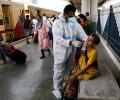
The number of people who have recuperated from the disease surged to 1,06,21,220 which translates to a national COVID-19 recovery rate of 97.29 per cent, while the COVID-19case fatality rate stands at 1.43 per cent.

India logged 16,135 new coronavirus infections taking the total tally of COVID-19 cases to 4,35,18,564, while the active cases increased to 1,13,864, according to the Union health ministry data updated on Monday.

Registering an increase for the seventh day in a row, the total active caseload has increased to 2,34,406 which now comprises 2.05 per cent of the total infections, while the recovery rate has further dropped to 96.56 per cent, the data stated.

According to NSSO, more than half of India's working-age population is out of labour force. In 2017-18, the youth unemployment rate was in the range 13.6-27.2 per cent.

The daily positivity rate was recorded at 0.17 per cent, while the weekly positivity was at 0.15 per cent, the health ministry said.

'Who are the people who are dying?' 'What is their profile?' 'We need to know these things.' 'We do not take health issues seriously.'
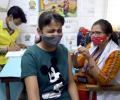
Delhi's R-value, which indicates the spread of COVID-19, was recorded at 2.1 this week, implying that every infected person is infecting two others in the national capital, according to an analysis by IIT-Madras.

The death toll stands at 5,30,698 with two fatalities with one reconciled by Kerala and one death reported from Maharashtra in the last 24 hours, the data updated at 8 am stated.

India on Wednesday recorded 16,047 new coronavirus cases and 54 fatalities including six reconciled by Kerala, according to the latest Union health ministry data.

The death toll due to the disease stands at 5,30,696 with one fatality being reconciled by Kerala, the data updated at 8 am showed.

The death toll stands at 5,30,695 with two fatalities reconciled by Kerala, the data updated at 8 am stated.

The minister also said that only 300-400 samples are being sent for genome sequencing now as sequencing of all samples is not possible.

Registering an increase for the 11th day in a row, the total active caseload has increased to 3,09,087, which now comprises 2.66 per cent of the total infections, while the recovery rate has further dropped to 95.96 per cent, the data stated.

The government hopes to use this data to assess the extent of financial support needed to recover from the pandemic.

The number of people who have recuperated from the disease surged to 1,72,80,844, while the case fatality rate was recorded at 1.09 per cent, the data stated.

With the fresh cases, the total tally of COVID-19 cases in the country climbed to 2,06,65,148.

Registering a steady increase, the active cases have increased to 30,84,814 comprising 16.79 per cent of the total infections, while the national COVID-19 recovery rate has further dropped to 82.10 per cent.

The national recovery rate has been pushed to 96.91 per cent on Wednesday.

Registering a steady increase for the 36th day in a row, the active cases have increased to 14,71,877 comprising 10.46 per cent of the total infections.

The average top executive monthly compensation is Rs 1 crore. The median employee salary is now Rs 820,000.

On Tuesday, the AIIMS also issued a statement that the e-hospital data has been restored.
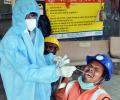
A total 16,577 infections were reported in a day, while the death toll increased to 1,56,825 with 120 new fatalities, the data updated at 8 am showed.

The COVID-19 case fatality rate was recorded at 1.49 per cent.

The rupee breached the 80-mark against the dollar on Tuesday. The steady depreciation in the value of the rupee against the US dollar is likely to prove expensive for corporate India. The listed companies' revenue expenses in foreign currency or imports exceed their export revenues or revenue earnings in forex. In their latest financial year, BSE500 companies, excluding banks and non-banking finance companies and insurance (BFSI), reported combined forex expenses of Rs 12.31 trillion against forex earnings of around Rs 10 trillion.

NITI Aayog has not said what the reasons were for having achieved or not having achieved what was sought to be achieved, or what lessons can be learned for the future, points out Aakar Patel.

The COVID-19 case fatality rate stood at 1.43 per cent.
